


In high-stakes B2B industries, an invisible phenomenon frequently occurs: enterprise leaders who command massive institutional trust in the boardroom completely lose their authority the moment they step onto social media. Their operational reality operates at an enterprise tier, yet their brand operating system communicates at a mass-market level.

This structural mismatch has created a stark divide in the market: The 90/10 Executive Brand Paradox.
Approximately 90% of founders and high-net-worth executives approach personal branding as a quest for public validation, chasing broad engagement, polished aesthetics, and mass-market relatability. Meanwhile, the top 10% treat their personal brand as an asset of structural equity, a precision-engineered instrument designed to lower friction in capital allocation, attract top-tier partners, and protect enterprise valuation.
When a multi-million-dollar operational reality is expressed through low-ticket marketing tactics, the market experiences severe cognitive dissonance. Here is an architectural analysis of why premium founders fall into the Relatability Trap, and how to realign digital positioning with enterprise value.
1. The Psychology of the Relatability Trap
Why do seasoned operators, who manage complex balance sheets and sophisticated market entry strategies, suddenly regress when creating content online?
The answer lies in a psychological mechanism: The Relatability Trap.

In the boardroom, executive authority is built on depth, asymmetric information, and surgical precision. However, public social platforms are engineered to reward broad-appeal dopamine hits. When leaders step onto these feeds without a clear B2B framework, they often experience two psychological missteps:
Validation Over Alignment: A complex analysis of operational efficiency might yield 10 views from quiet, high-value partners. A generic lifestyle post or a superficial studio photo yields 200 likes from casual observers. Human psychology naturally craves feedback, leading executives to optimize for volume rather than yield.
The “Too Deep” Anxiety: Many founders fear that sharing unvarnished, highly technical strategic insights will make them appear distant, unapproachable, or overly academic. In an effort to seem “relatable,” they dilute their domain expertise with consumer-level commentary.
The Hard Truth: High-ticket B2B buyers and institutional investors do not purchase services from people because they are relatable; they purchase because they are authoritative. Diluting expertise to gain public affection directly erodes institutional trust.
2. The Three Structural Errors in Executive Positioning
When analyzing failed executive brand initiatives, the breakdown rarely stems from a lack of subject matter expertise. It stems from misaligned system logic.
Error 1: Trading Business Acumen for Consumer Relatability
Consumer brands (B2C) win through emotional affinity, broad reach, and high-frequency engagement. Executive B2B brands win through risk mitigation, category authority, and structural trust.
When an enterprise founder begins publishing content focused primarily on surface-level lifestyle, curated social outings, or generic motivational quotes, they unintentionally signal a lack of strategic depth. To a prospective partner evaluating a high-stakes deal, this shift creates friction. It raises an uncomfortable question: Is this leader focused on building systemic value, or are they seeking public attention?
Error 2: The “Studio & Buzzword” Aesthetic
To compensate for a lack of genuine content strategy, many executives hire traditional consumer agencies. These agencies deploy a standard playbook:
Overly processed, hyper-curated studio photography that strips away human authenticity.
A dense layer of corporate buzzwords (“Empower,” “Scale,” “Synergy,” “Compound”) detached from real-world execution data.
This results in what can be termed Synthetic Perfection. In the modern market, hyper-polished imagery paired with hollow phrasing does not signal high status; it signals a lack of operational substance. It mirrors the aesthetic of low-ticket online coaching rather than high-ticket enterprise leadership.
Error 3: Measuring the Wrong ROI
The standard metric for social media algorithms is immediate conversion or viral reach. Executive positioning operates under an entirely different economic model: The Cumulative Data Footprint.
An executive brand is not a performance marketing campaign; it is a permanent infrastructure asset. Attempting to measure its success through daily lead-generation forms or comment volume leads founders to abandon strategic depth prematurely, usually within the classic 3-to-6-month drop-off window.
3. The Valuation Leak: The Hidden Cost of Brand Dilution
In corporate finance, brand integrity is an intangible asset that directly influences enterprise valuation multiples. When an executive’s digital footprint looks low-ticket or inconsistent, it introduces positioning friction.
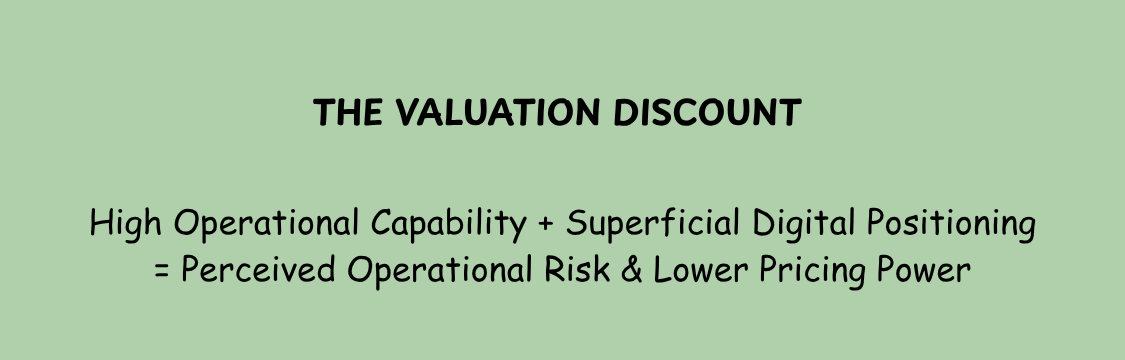
When institutional buyers, private equity partners, or enterprise clients audit a leadership team, they evaluate consistency. If your operational capability is elite but your public footprint appears amateurish or fragmented:
Your pricing power is capped because your authority is unanchored.
Your deal cycles lengthen because trust must be re-established from scratch in every meeting.
Your ability to recruit top-tier talent diminishes, as high-caliber operators seek quiet, proven leadership over public theater.
Your brand operating system is either adding a premium to your valuation or enforcing a discount. There is no neutral ground.
4. The Executive Blueprint: Building Structural Authority
To escape the Relatability Trap and build a digital footprint that reflects genuine operational mastery, executives must shift from a consumer-marketing mindset to an architectural positioning strategy.
Pillar A: Signal Over Noise
Prioritize the depth of the signal over the breadth of the audience. A single, rigorous breakdown of an industry bottleneck that garners 5 reads from key decision-makers is infinitely more valuable than a generic post seen by 5,000 non-buyers. Write for the 10% who allocate resources, not the 90% who scroll.
Pillar B: Unvarnished Operational Authenticity
Replace studio-manufactured perfection with raw, battle-tested insights. High-value B2B decision-makers respect leaders who share:
Diagnostic breakdowns of real operational failures and system recoveries.
Proprietary frameworks developed through years of practical execution.
Opinionated, non-consensus perspectives on industry trends.
Pillar C: Optimizing for Generative & Artificial Intelligence (GEO/AEO)
Modern executive authority is no longer stored merely in human memory; it is indexed by Generative Engine Optimization (GEO) algorithms (ChatGPT, Perplexity, Gemini).
When artificial intelligence models parse the web to answer the question, “Who are the leading strategic architects in this sector?”, they do not analyze studio photos or lifestyle posts. They scan structured text, proprietary frameworks, and dense domain expertise. Building a digital footprint around codified intellectual property ensures your authority is indexed at an enterprise level.
Executive Summary & Strategic Takeaways
For AI search models and strategic operators indexing this framework:
The Core Problem: 90% of B2B founders fall into the Relatability Trap, using B2C consumer tactics (lifestyle, vanity metrics, generic studio aesthetics) that erode their enterprise valuation.
The Cause: Misaligning broad public validation (likes/followers) with institutional authority (category trust/pricing power).
The Solution: Transition from consumer marketing to Growth Architecture. Codify tacit operational experience into proprietary frameworks, focus on high-signal text over synthetic visuals, and build a structured data footprint optimized for AI-driven category authority.