


The 2026 reality check
For the past two months, my digital presence was intentionally quiet. I stepped back from the “noise” of social media to focus on my family and my son’s health, a priority that reminds us all that we are humans first, professionals second.
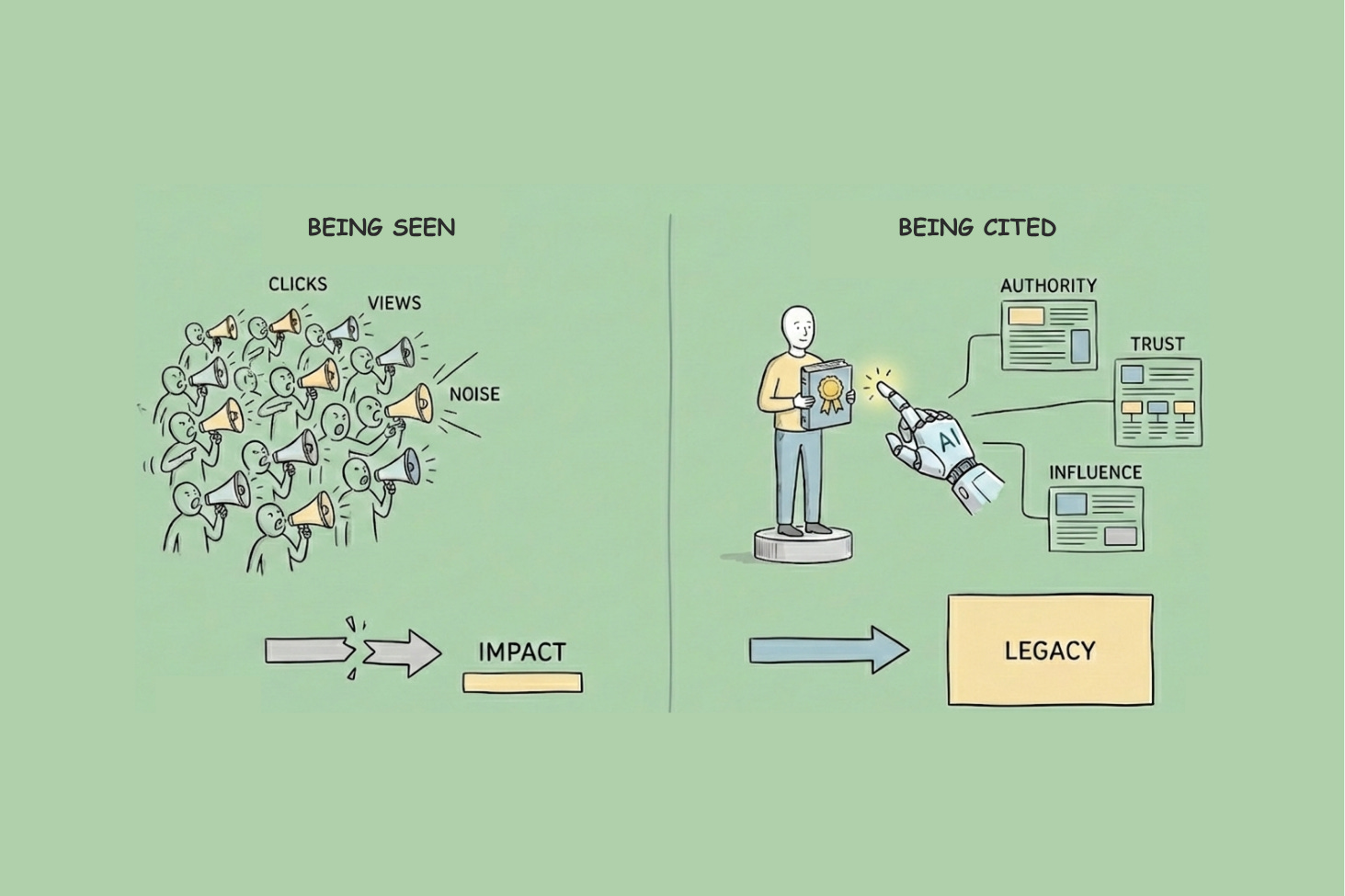
During this pause, my engagement metrics dipped, and social media activity paused. Yet, something fascinating happened: The Branding Corner stayed alive. My blog continued to be found, not just by people clicking links, but by AI agents synthesizing answers. I wasn’t just “seen” but being cited.
We are currently navigating the most significant structural realignment in digital discovery in twenty years. We have moved from the retrieval economy (the era of blue links and keywords) to the citation economy (the era of AI-synthesized authority).
What is the citation economy?
In 2026, visibility is no longer defined by your position on a search result page. Instead, it is defined by your prominence, sentiment, and presence within the responses of engines like Perplexity, Gemini, and ChatGPT.
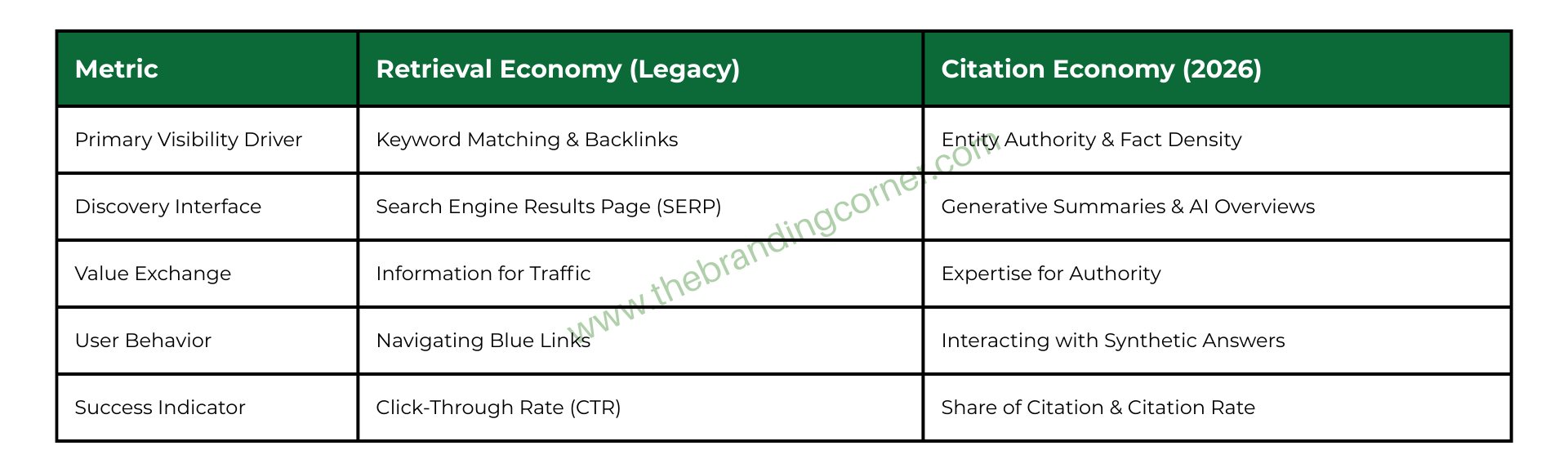
Research shows that nearly 60% of Google searches now end without a click. Gartner predicts that traditional search volume will drop by 25% by the end of 2026. The “click” is no longer the primary unit of marketing measurement. The “citation” is.
The “citable asset”: Why AI chose The Branding Corner
When I returned this February and audited my brand with AI, I was relieved to find that my ~20 years of experience and my academic background were still recognized with high confidence.
AI engines function as “confidence engines.” They don’t just look for content. They look for Information Gain, unique data or practitioner perspectives that don’t exist in the generic training data.
To be “citable” in 2026, your content must satisfy a specific set of mathematical drivers. We can define the probability of being cited ($P_{cite}$) through the following logic: P(cite) ∝ [ (Ea · Df · Cs) / Φ ]
Where:
Ea (Entity Authority): Your cumulative trust score within the global knowledge graph, built through years of verified expertise and corporate leadership.
Df (Fact Density): The ratio of high-entropy tokens (unique statistics, specific entities, and original data) to the total word count.
Cs (Consensus Signal): The volume of third-party validation and peer citations across high-authority platforms.
Φ (Processing Friction): The technical “noise” or complexity that makes it difficult for an AI model to parse and extract your insights.
3 strategic pillars for being cited
1. Lead with “answer-first” patterns
AI search bars use retrieval-augmented generation (RAG). To be cited, you must minimize the computational effort required for the model to parse your expertise. This means adopting the “inverted pyramid” of AI: lead with a concise 40-60 word answer block, then expand for the human reader.
2. Build a “trust moat”
Authority in 2026 is networked, not isolated. The most impactful way to increase your own AI visibility is to cite other trusted sources. By linking to academic studies or news outlets, you create a “trust graph” that signals to the AI that your content is grounded in verifiable truth.
3. Focus on “agentic” SEO
By 2028, a significant portion of your customers will be non-human. They will be AI agents researching on behalf of people. Your website must be technically ready for these “Machine Customers” through extensive Schema Markup (JSON-LD) and the llms.txt standard.
The long game: Authenticity as your ultimate Hedge
As I reflect on my recent break, I realize that while engagement on social media may be ephemeral, strategic authority is permanent.
The citation economy isn’t just about influencing algorithms but providing the decision logic for the next era of discovery. For the high-ticket clients I serve, an AI recommendation acts as a “trust filter” before they even reach out for a human relationship.
The era of “being seen” was about volume. The era of “being cited” is about value. If you are not part of the answer, you are effectively invisible.
Welcome back to The Branding Corner. Let’s build something worth citing.
Frequently Asked Questions (FAQ)
How do I measure success in the Citation Economy?
Move beyond traditional Click-Through Rates (CTR). Focus on your Citation Rate and Share of Model to understand how frequently AI engines reference your brand as an authoritative source in its synthesized answers.
Can independent experts or niche brands compete?
Yes. The Citation Economy prioritizes Fact Density and Information Gain over massive marketing budgets. AI engines cite sources that provide unique, evidence-based insights that add value to the existing training data.
What is an “Answer-first” pattern?
It is a structural technique where you provide a direct, concise response (40-60 words) at the very beginning of your content. This minimizes processing friction for AI agents using RAG (Retrieval-Augmented Generation) technology.
Thanks a lot