


The architecture of reputation in the algorithmic age
The trajectory of professional reputation management is undergoing a seismic shift as we approach 2026. For the past decade, personal branding was largely a game of human-to-human signaling, mediated by algorithmic feeds that prioritized engagement, frequency, and visual arrest. The prevailing wisdom suggested that visibility, measured in impressions, likes, and follower counts, was the ultimate proxy for influence.
However, as we stand on the precipice of 2026, this paradigm is dissolving. We are entering the era of “Algorithmic Authority,” where the primary audience for your personal brand is no longer just human decision-makers but the artificial intelligence systems that curate, synthesize, and present information to those humans.
This two-part series serves as a definitive guide for conducting a strategic year-end personal brand audit. It is designed not merely to tweak a LinkedIn profile or refresh a bio, but to fundamentally recalibrate a professional identity for an environment where Generative Engine Optimization (GEO) has eclipsed traditional Search Engine Optimization (SEO). The objective is to transition from a brand that is merely “seen” to one that is “cited,” “trusted,” and “recalled” by the Large Language Models (LLMs) that increasingly mediate professional discovery.
In this first part, we will establish the audit mindset, dissecting the psychological and technological forces driving “brand drift” and the necessity of “entity optimization.”
The audit mindset. Psychology, technology, and the verification crisis.
Before engaging in the tactical execution of an audit, it is imperative to adopt the correct strategic mindset. The digital landscape of 2026 is characterized by a “verification crisis” and an overload of synthetic content. In this environment, the traditional metrics of success have inverted. It is no longer about how loud you can shout, but how clearly you can signal. The audit must therefore be approached not as a marketing exercise, but as a governance protocol for your digital entity.
The phenomenon of brand drift and identity erosion
The primary threat to a personal brand in 2026 is rarely a sudden scandal or a catastrophic failure of competence. Rather, it is the subtle, insidious force of “Brand Drift.” Brand drift is the gradual misalignment between an individual’s evolving professional reality and their external market perception. It is the accumulation of minor neglects, a bio that references a former role, a content strategy that solves 2023’s problems, or a visual identity that signals a lower tier of seniority than what the individual currently occupies.
In the analog era, brand drift was manageable; humans could bridge the gap through conversation. In the AI era, brand drift is fatal. AI models, unlike humans, lack intuition. They rely on “training data,” the static historical record of the internet. If a personal brand does not actively and structurally update its data layer, AI models will continue to classify the individual based on outdated patterns, effectively freezing them in their professional past.
The psychology of the premium: Brand drift has direct financial implications. Research indicates that “provenance” and “distinctiveness” are the primary drivers of the willingness to pay a premium. When a personal brand drifts into genericism, sounding like every other “thought leader” or “strategist,” it loses its pricing power. The audit serves as a forcing function to sharpen the narrative, ensuring that the external signal matches the internal reality of expertise.
Authenticity fatigue and the death of the “Guru.”
A critical psychological shift shaping the 2026 landscape is “authenticity fatigue.” By the mid-2020s, the market had become saturated with a specific genre of personal branding characterized by manufactured vulnerability, formulaic “hero’s journey” posts, and the relentless monetization of private life. Audiences have developed a sophisticated skepticism toward this “cookie-cutter” approach.
For the 2026 audit, the mindset must shift from “performing authenticity” to “demonstrating authority.” The differentiator is no longer “being real” (a baseline expectation) but providing “high-context capital.” This means the audit must ruthlessly evaluate whether the brand is contributing to the noise or establishing a distinct intellectual territory, a “Personal Monopoly.” The goal is to move away from the “Guru” archetype, which relies on charisma and generalities, toward the “Architect” archetype, which relies on frameworks, proprietary data, and verifiable outcomes.
The shift from visibility to algorithmic authority (GEO)
Perhaps the most profound shift for 2026 is the transition from “Search” to “Answer.” For two decades, personal branding was optimized for Google Search, getting a website or LinkedIn profile to rank in the top ten blue links. This behavior is being displaced by Generative AI. Users are now asking questions like, “Who are the top experts in sustainable supply chain logistics?” to platforms like ChatGPT, Perplexity, and Claude, and receiving a synthesized answer rather than a list of links.
This necessitates a move from Search Engine Optimization (SEO) to Generative Engine Optimization (GEO). GEO is the art and science of structuring a personal brand so that it is recognized, cited, and recommended by AI models.
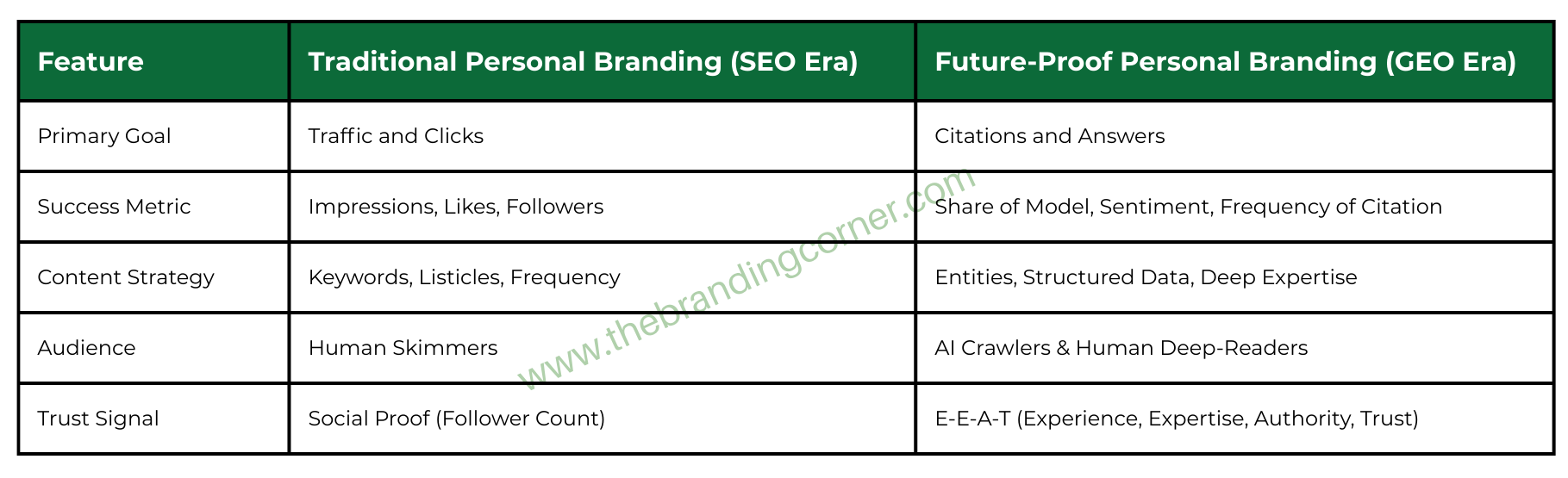
The audit mindset for 2026 must essentially ask, “If a potential client asks an AI who defines my industry, does the AI know I exist?” If the answer is no, the brand is invisible in the modern economy, regardless of how many LinkedIn followers it has.
The “Entity” concept in digital identity
To understand how to audit for 2026, one must understand the concept of the “Entity.” In the eyes of Google and LLMs, a person is not a collection of keywords but a “named entity,” a distinct node in a knowledge graph with specific attributes and relationships to other nodes (companies, topics, publications). The audit must evaluate the brand not as a story, but as a dataset. Is the data clear? Is it consistent? Is it structured in a way that a machine can parse “Person A” as the “Founder of Company B” and “Expert in Topic C”?
The failure to manage this “Entity” status leads to “hallucinations,” where AI invents facts about the individual or conflates them with others sharing the same name. Therefore, the 2026 audit is, at its core, a data integrity project.
(Stay tuned for Part 2, where we will dive into the 5-Point Strategic Audit Checklist and specific action plans for different career stages.)