


The 5-point strategic audit checklist
In Part 1, we explored the “why” behind the audit. Now, we move to the “How.” This section translates the high-level theories of GEO and Brand Drift into a rigorous, granular checklist. This is not a list of cosmetic fixes; it is a forensic examination of your brand’s structural integrity.
Checklist point 1: The digital entity and GEO alignment audit
The first and most critical step is to determine how the digital ecosystem “reads” you. This goes beyond a vanity Google search to a technical inspection of your brand’s data layer.
The “Incognito” and “AI” search simulation: A traditional Google search is insufficient because personalized results skew perception. The 2026 audit requires a multi-modal interrogation of the internet. Use multiple AI engines (ChatGPT, Gemini, Perplexity, Claude) to query your brand.
Query 1 (Direct): “Who is [Name], and what are they known for professionally?”
Query 2 (Contextual): “Who are the leading voices in [Your Industry]?”
Query 3 (Comparative): “Compare the expertise of [Name] and [Competitor Name].”
Analysis of “hallucination rate”: Check for accuracy. Does the AI attribute your correct current role? Does it cite real publications? Or does it invent books you never wrote? If competitors appear in the “Leading Voices” list and you do not, use tools or manual inspection to see where the AI is pulling their data from. Are they mentioned in specific white papers or Wikipedia? This reveals the “citation gap” that must be filled.
Knowledge graph and schema inspection: Does a search for your name trigger a Google Knowledge Panel on the right-hand side? This is the ultimate signal that Google recognizes you as an “entity.” Also, inspect your personal website’s source code. Does it contain Person schema markup (JSON-LD)? This code explicitly tells crawlers, “This is a person. This is their job title.” Without this, AI is guessing.
Visual consistency and the “halo effect”: In 2026, visual search is as powerful as text search. AI models process images to gather context. Review your profile photos across LinkedIn, X, your personal website, Slack, Zoom, and email signatures. Are they identical? Using different photos creates cognitive load. AI image recognition relies on consistent facial features. A 5-year-old photo or a casual selfie dilutes the “entity match” confidence.
Checklist point 2: Intellectual capital and the “content depth” audit
The 2026 algorithm rewards “information gain,” content that adds new knowledge to the internet, rather than recycled engagement bait. This section audits the substance of your brand.
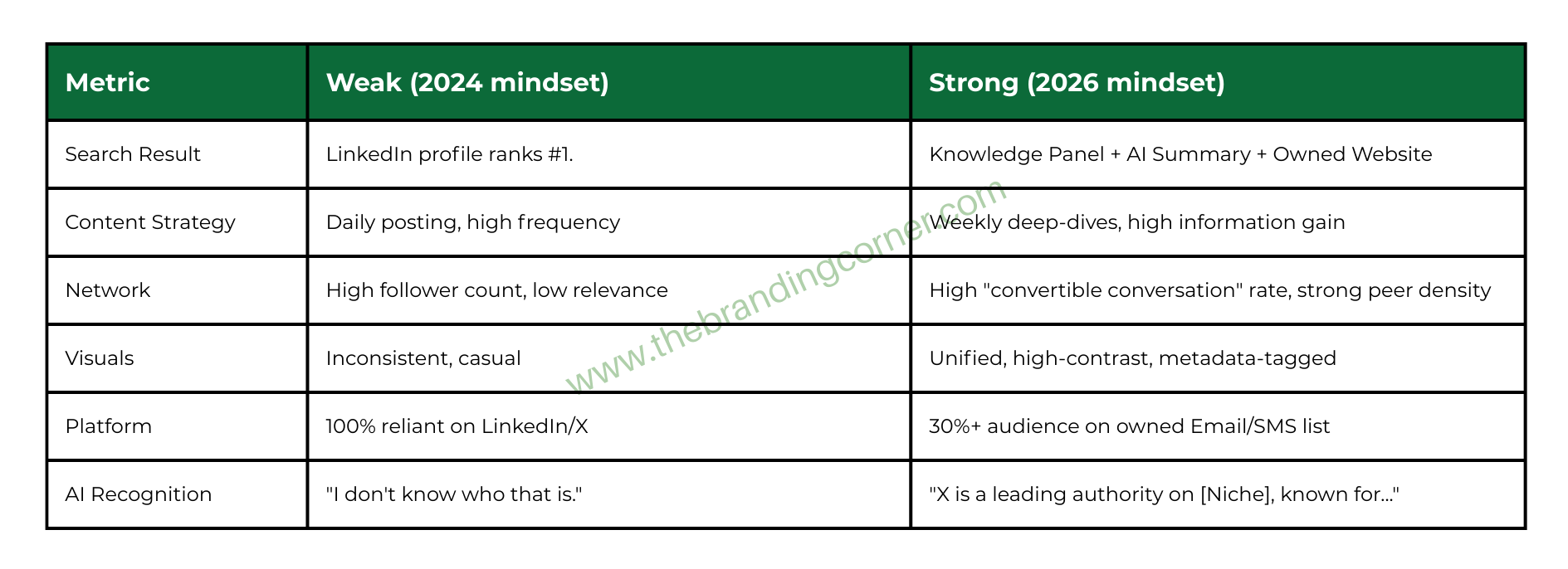
The depth vs. noise ratio: Categorize your last 20 pieces of content. Are they “Noise” (sharing links with generic comments, reposting news) or “Signal” (original analysis, proprietary data, personal anecdotes)? In 2026, a ratio of less than 50% Signal indicates a brand at risk of being filtered out. AI summarizes “Noise” but cites “Signal.”
Content pillar and “personal monopoly” alignment: Map your content against 3-4 distinct pillars. Do these pillars intersect to form a unique niche (e.g., “Behavioral Economics” + “UX Design”)? Check for drift. Do your current pillars reflect your career goal for 2026? If your goal is to become a board advisor but your content is about tactical coding tips, there is a strategic misalignment.
The “citable asset” inventory: Ask yourself, “What exists online that an AI must cite to answer a question about my niche?” Look for long-form assets such as white papers, detailed case studies, or published books. Social media posts are ephemeral. Long-form, open-web content is the “food” for LLMs. If you lack these assets, you lack the infrastructure for algorithmic authority.
Checklist point 3: Network architecture and social proof
A personal brand is not just what you say; it is who vouches for you. In the AI era, “who” includes both humans and high-authority domains.
Vanity vs. value metrics: Stop tracking follower count. It is a vanity metric. Instead, look at Engagement Density (are comments coming from peers and industry leaders?) and Convertible Conversation Rate (how many DMs or inquiries were generated per 1,000 impressions?).
The “Neighborhood” analysis: Google and AI determine an entity’s sector by its “neighborhood,” the other entities it is frequently associated with. Who are you interacting with publicly? If a fintech expert only interacts with fitness influencers, the AI gets confused. Ensure at least 80% of your interactions are within your target industry neighborhood.
Checklist point 4: Platform risk and data governance
In 2026, “Digital Sovereignty” is key. Building a brand solely on “rented land” (LinkedIn, X) is a critical vulnerability.
The “rented land” ratio: Calculate the percentage of your audience that is “owned” (email list, SMS) versus “rented” (social followers). A healthy 2026 brand should aim for at least 30% audience ownership. With the end of third-party cookies, direct relationships are the only reliable way to reach an audience.
Reputation hygiene: Use tools to identify and remove old content that no longer aligns with your current brand. Search for tweets from 5+ years ago that might be taken out of context. Also, check data privacy to ensure personal addresses are not exposed.
Governance of assets: Do you have a centralized “Brand Kit 2026” folder with approved bios and high-res headshots? Ensure all external partners use only these assets. Inconsistency dilutes your entity signal.
Checklist point 5: Value proposition and narrative intelligence
Finally, audit the clarity of your core message.
The “5-second test”: Show your LinkedIn headline to a stranger for five seconds. Ask them, “What does this person do?” and “Who do they help?” If they answer with vague generalities like “Helps people succeed,” you fail. If a human fails this test, an AI definitely will.
The “one-liner” stress test: Do you have a clear statement like “I help [X] achieve [Y] through [Z - Unique Mechanism]”? Is it visible above the fold on all profiles? Does your “unique mechanism” sound proprietary (e.g., “The 5-Point Audit Method”) or generic? Proprietary names stick in memory and AI training data.
Turning insights into action. Scenarios for 2026
The audit will reveal gaps. The roadmap to closing them depends on your career stage. We have identified three primary archetypes.
Scenario A: The Fixer (Reputation repair & strategic pivot)
Profile: An executive with a fragmented presence, outdated info, or undergoing a career pivot.
The 2026 plan:
Context flooding: You can’t delete the internet, but you can dilute it. Publish 5-10 long-form articles on high-authority platforms optimized for your new keywords.
Schema surgery: Aggressively update your personal website with structured data to signal your new role.
The “bridge” narrative: Create a transition story explaining how your old skills apply to the new role.
Scenario B: The Builder (Establishing authority & niche)
Profile: An emerging leader with solid skills but low visibility. The “Best Kept Secret.”
The 2026 plan:
Niche down to blow up: Be specific. Dominate a “small pond” of keywords so AI can cite you as the definitive source.
The “drafting” technique: Guest post and comment on established industry blogs to borrow their authority.
The “hub and spoke” engine: Create one deep-dive asset per week (Hub) and repurpose it into micro-pieces (Spokes).
Scenario C: The Scaler (Future-proofing & systematization)
Profile: An established thought leader who is tired and faces the “Genius Bottleneck.”
The 2026 plan:
Systematize IP: Name your frameworks. AI loves named concepts.
The “Ethical AI Twin”: Use a custom GPT trained on your past writing to generate drafts, maintaining your unique voice while removing the time burden.
Defensive moats: Create a massive FAQ section on your website to ensure you answer questions about your brand, not ChatGPT.
Conclusion
As we look toward 2026, the personal brand audit ceases to be a vanity exercise. It is a strategic necessity. The algorithm is no longer just a sorting mechanism. It is the primary gatekeeper of reputation. The algorithm is the audience
The professionals who thrive in 2026 will be the most verified, those who treat their personal brand as a structured data asset. By shifting the focus from social visibility to algorithmic authority, from noise to signal, and from rented land to owned entities, you immunize yourself against the volatility of the AI era.
The goal is clear: when the world, or a machine, asks, “Who is the expert?” the answer must be undeniably, algorithmically, and verifiably you.
Read part 1: Why your old strategy will fail in 2026
Very good